
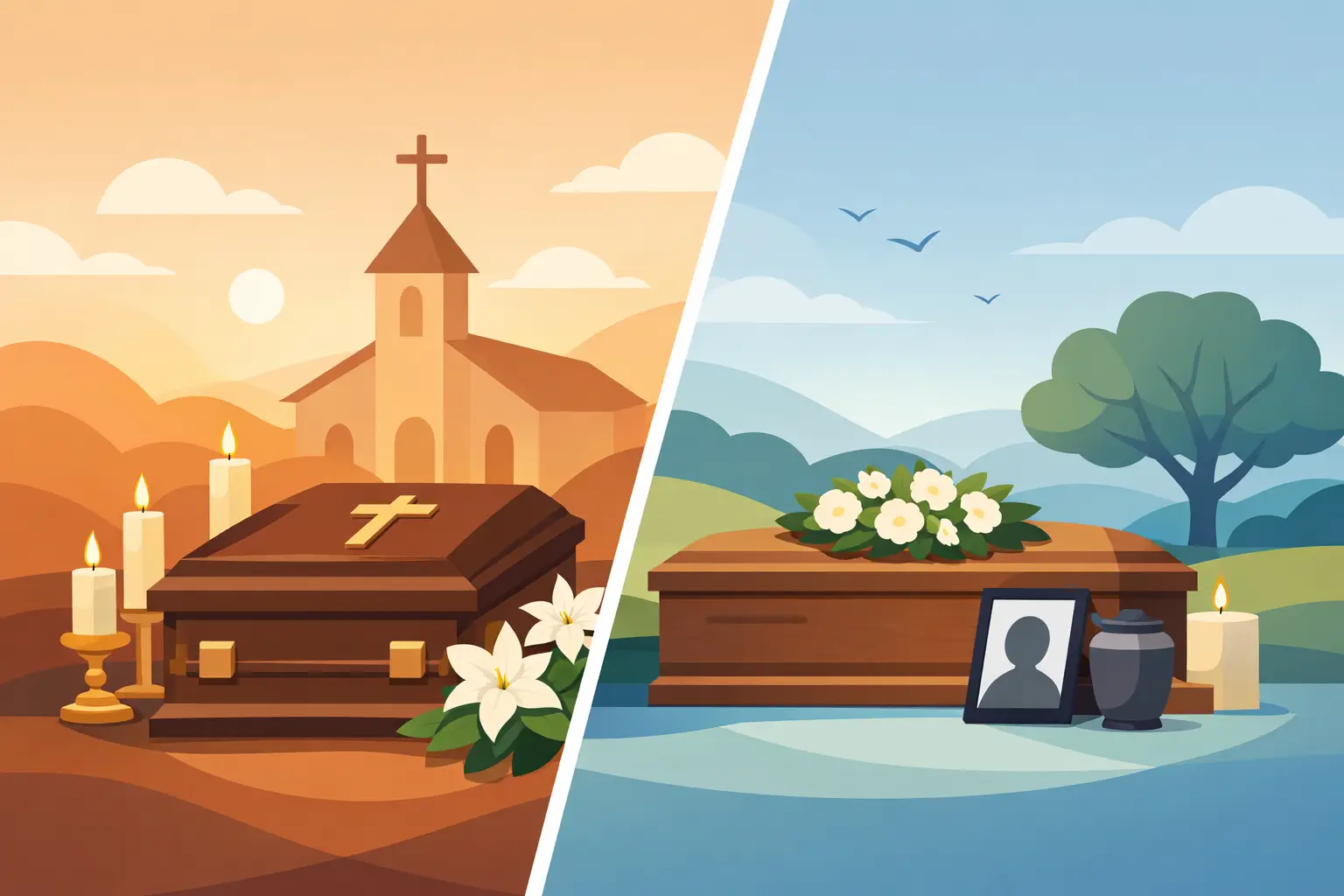
Religious or Nonreligious Funeral: Which to Choose?
A religious or nonreligious funeral is not simply a choice between a church service and a crematorium ceremony. It is a decision about how to reflect the person who has died, while giving those closest to them space to say goodbye in a way that feels truthful. For many families, the answer is clear. For others, especially where relatives hold different beliefs, it can be one of the harder decisions to make.
There is no requirement for a funeral to fit neatly into one category. A ceremony can be rooted in faith, wholly secular, or thoughtfully shaped around elements of both. What matters is that it feels respectful, personal and manageable for the family.
What is a religious funeral?
A religious funeral follows the beliefs, customs and traditions of a faith. It may be held in a place of worship, at a crematorium chapel, graveside or cemetery chapel. A priest, minister, rabbi, imam or other faith leader will usually lead the service, offering prayers, readings, blessings and rituals that are meaningful within that tradition.
For some people, faith was central throughout their life. A religious service can provide familiar words and rituals at a time when little else feels certain. Hymns, scripture readings, a eulogy, prayers for the person who has died and a committal can bring comfort not only to immediate family but also to the wider congregation or community.
The exact format depends on the faith and the wishes of the family. Some Christian funerals include a service in church followed by burial or cremation. Muslim funerals usually take place promptly and follow particular rites for washing, prayer and burial. Jewish, Hindu, Sikh and other faith traditions each have their own customs, timings and requirements. A funeral director can help coordinate practical arrangements while respecting these important details.
A religious funeral does not have to be formal in every respect. Families may still choose favourite music for arrival or departure where appropriate, personal flowers, photographs, a distinctive coffin, or a warm eulogy that captures the person beyond their faith.
What is a nonreligious funeral?
A nonreligious funeral, sometimes called a secular, civil or humanist funeral, is led without religious worship. It can take place at a crematorium, cemetery chapel, natural burial ground, a venue licensed for funerals, or another suitable setting. A civil celebrant or humanist celebrant may lead the ceremony, although a family member or friend can also speak and guide parts of the service.
The focus is usually on the individual’s life, relationships, character and contribution. The ceremony might include readings, poems, live or recorded music, tributes, photographs and a time of reflection. There can be silence rather than prayer, or words that acknowledge love, loss and memory without referring to a particular faith.
Nonreligious does not mean impersonal. In fact, it can offer considerable freedom. A keen gardener might be remembered with flowers from the garden and a reading about the seasons. A lifelong music lover may have songs chosen by family and friends. Someone known for bringing people together may be honoured through several short memories rather than one formal eulogy.
It is worth knowing that a humanist ceremony is specifically nonreligious and will not usually include hymns or prayers. A civil celebrant can often be more flexible if the family would like a spiritual reading, a moment of prayer, or a hymn alongside otherwise secular content. Asking about this early helps avoid assumptions.
Choosing between a religious or nonreligious funeral
Begin with the person who has died. Did they leave funeral wishes, discuss their beliefs, attend a place of worship, or make clear that they did not want religion included? Their preferences should guide the arrangements wherever possible, even when family members have different views.
If no wishes were left, consider the life they led rather than trying to find a perfect answer. Their upbringing may have been religious, but faith may no longer have played a part in adult life. Equally, someone who did not regularly attend services may still have found great comfort in prayer or traditional hymns. A familiar ritual can be meaningful for relatives, but it should not override what the person themselves would have wanted.
Practical factors may also affect the choice. A place of worship may have its own availability and expectations for services. A crematorium chapel has a booked time slot, so readings and music need to be planned with care. Certain faiths require burial within a particular timeframe. These details can be handled calmly when arrangements are discussed from the outset.
Cost is another reasonable consideration. The cost of a funeral can vary according to venue, minister or celebrant fees, burial or cremation fees, vehicles, coffin choice, flowers and other personal requests. A clear, itemised price discussion allows families to make decisions that are right for their budget without compromising dignity.
When family beliefs differ
It is common for one part of a family to want prayers and another to prefer a secular ceremony. This can feel particularly difficult when everyone is grieving. A balanced service is often possible.
For example, a civil celebrant might lead a predominantly nonreligious ceremony that includes a short prayer at the end, a hymn loved by the person who died, or a reading from a faith tradition. Alternatively, a religious service can include a personal eulogy, contemporary music at an appropriate point and tributes that show the full shape of someone’s life.
The key is to be honest about what each element means. A hymn chosen because it was a grandparent’s favourite can be a loving tribute. A prayer can be included for relatives who draw comfort from faith. Neither needs to turn the ceremony into something the person would not have recognised.
The role of a celebrant, clergy member and funeral director
A clergy member brings knowledge of religious rites and can offer pastoral support to families. They will usually guide the order of service and explain what is customary, while making room for personal choices where possible.
A celebrant creates and leads a bespoke ceremony. They may meet with the family to hear stories, gather memories and write a tribute that reflects the person’s life. Civil and humanist celebrants have different approaches, so it is sensible to explain clearly whether you would like any religious content.
Your funeral director coordinates the arrangements around the service. This can include liaising with the crematorium or cemetery, clergy or celebrant, arranging the coffin and funeral vehicles, preparing notices, helping with flowers, and ensuring the day follows the agreed plan. At Adrian Moore Funerals, families across Catford and South London can talk through these choices without pressure, whether arrangements are being made in advance or following a death.
Ways to make the ceremony feel personal
Faith and personality can sit together naturally. The most moving funerals tend to have details that sound and feel like the person being remembered, rather than following a format for its own sake.
Consider the tone they would have appreciated. Some people would have wanted quiet formality; others would have preferred warmth, colour and stories that make people smile through tears. Music often sets this tone quickly. A religious service may include hymns alongside a favourite recording, while a secular service may use a poem, a sporting anthem or a piece of instrumental music to create a moment of reflection.
Visual choices matter too. Flowers, photographs, clothing and the coffin can all reflect personality, heritage or values. Families considering an eco-friendly funeral may wish to discuss a natural coffin, locally sourced flowers or a woodland burial. LGBTQ+ families should also feel entirely free to reflect the relationships, chosen family and identity that mattered most to the person who died.
Give yourselves permission to take guidance
When grief is fresh, even small choices can feel overwhelming. You do not need to know the correct words, the order of service or whether a certain reading is allowed before you speak to a funeral director. Those questions are part of the arrangement process, not a test you need to pass.
If you are unsure, start with one simple question: what would make this farewell feel most like them? From there, the right balance of faith, tradition, music, memories and practical arrangements often becomes clearer. If a death has occurred and you need support, contact a funeral director at any time of the day or night so you do not have to carry the decisions alone.
