
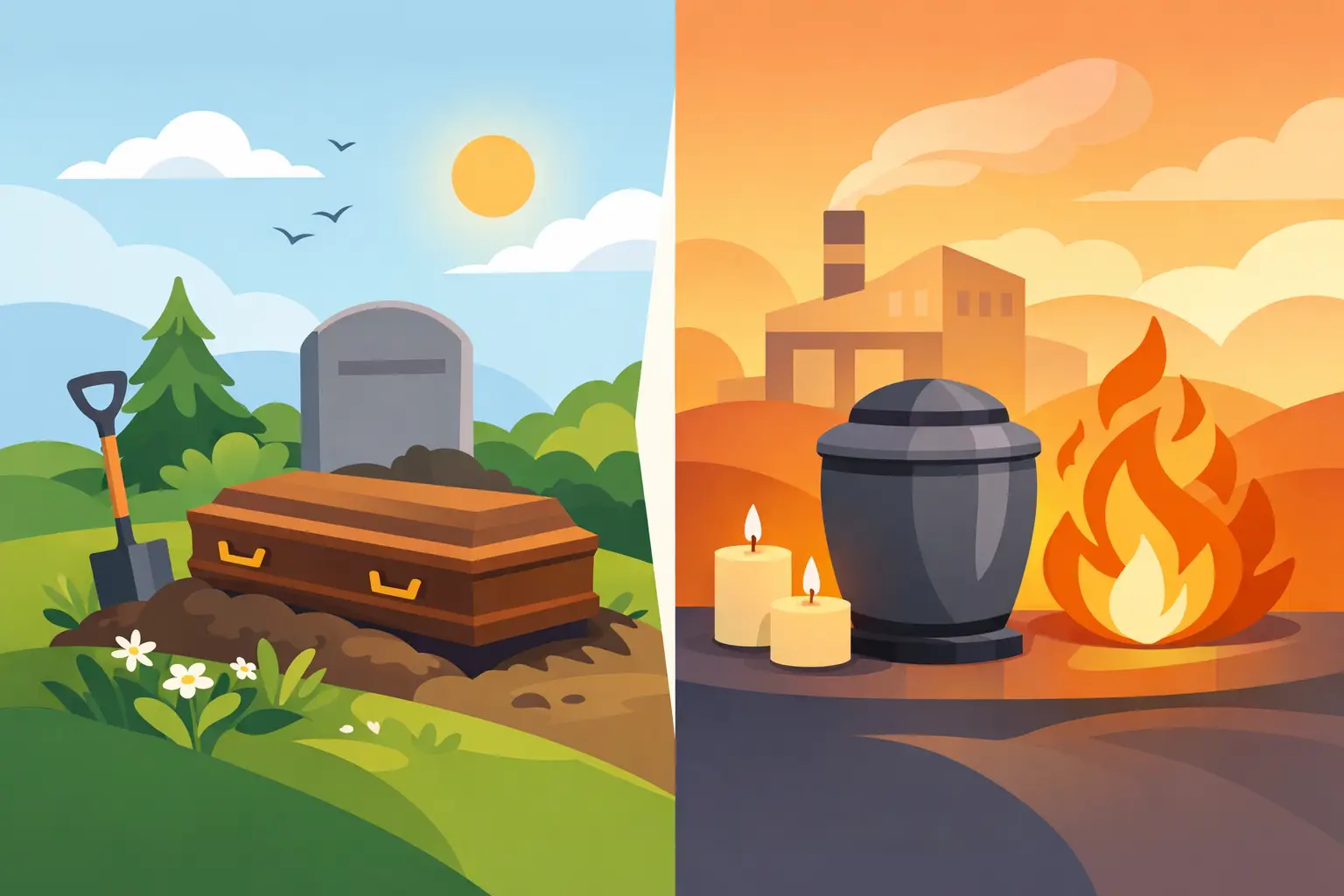
Burial or Cremation: What Changes?
When a family sits down to arrange a funeral, one question usually shapes almost every other decision – burial or cremation? It can feel like a very practical choice, but for many people it is also emotional, cultural, religious and deeply personal.
The right answer is not the same for every family. Some people have clear wishes set out in advance. Others leave no instructions at all, and relatives are left trying to choose what feels most fitting. Understanding the difference between burial and cremation can make that decision feel less daunting and help you plan a funeral that is respectful, personal and manageable.
The difference between burial and cremation at a glance
The simplest difference is what happens to the body after the funeral.
With burial, the deceased is placed in a coffin and laid to rest in a grave or burial plot. That may take place in a cemetery, churchyard or natural burial ground, depending on the family’s wishes, local availability and any faith requirements.
With cremation, the coffin is taken to a crematorium, where the body is cremated after the funeral service or following a separate committal. The ashes are then returned to the family or handled according to instructions. They may be kept, buried, scattered or placed in a memorial setting.
That may sound straightforward, but the choice affects the timing, cost, location, service style and the decisions a family may need to make afterwards.
How the funeral service differs
A burial funeral often moves from one place to another. There may be a service in a church, mosque, temple, chapel or other venue, followed by a procession to the cemetery or burial ground for the committal. In some cases, the full service happens graveside.
A cremation service is usually held at the crematorium chapel, although it can also begin elsewhere before the coffin travels on for cremation. Some families choose a full attended cremation service. Others prefer a smaller gathering and hold a memorial later.
Neither option is more meaningful than the other. What changes is the shape of the day. Burial can feel traditional and place-based, especially if there is an existing family grave. Cremation can offer more flexibility, particularly where families want time to decide what to do with the ashes or plan a memorial separately.
Cost differences families should know about
For many families, cost is an important part of the decision. It is sensible to talk about this plainly.
Burial is often more expensive than cremation, though not always. The largest burial costs can include the purchase of a grave, burial fees, grave preparation and memorial costs. If a family already owns a burial plot or has rights in an existing grave, that can alter the picture significantly.
Cremation fees are usually lower than the total cost of a new burial plot, but there may still be separate charges for the crematorium, service time, ashes container and any later interment or memorial arrangement.
This is why transparent pricing matters. The headline figure rarely tells the whole story. A funeral director should explain clearly what is included, what is optional and which third-party fees apply. For families trying to balance wishes with budget, that clarity can bring real peace of mind.
Timing and practical arrangements
Burial and cremation also differ in how quickly arrangements may need to be made.
A burial depends on cemetery or burial ground availability, grave preparation and any paperwork needed for the interment. Certain faith communities may wish for burial to take place as soon as possible, which can make experienced funeral support especially important.
Cremation depends on the availability of the crematorium and the completion of the legal documents required for cremation. In many cases, families find cremation offers slightly more flexibility with dates and times, but this can vary by area and by season.
The practical side matters more than people sometimes expect. If many relatives are travelling, if there are urgent religious needs, or if a family needs more time to gather and decide on the service, one option may fit better than the other.
Religious, cultural and personal wishes
For some families, the choice is already guided by faith or culture. Certain religions have strong traditions around burial, while others may permit either burial or cremation. Some people are not religious but still feel strongly because of family custom, heritage or personal preference.
This is often where the conversation becomes most sensitive. A son may want to follow what his mother said informally years ago. A partner may have different views from extended family. Siblings may disagree about what feels respectful.
In those moments, it helps to come back to the person who has died. What suited them? Were they traditional or practical? Did they value a grave that could be visited, or would they have preferred a simpler approach? A thoughtful funeral is not about pleasing everyone completely. It is about making a decision that can be honestly defended as caring and appropriate.
The role of ashes and memorials
One of the clearest practical differences between burial and cremation comes afterwards.
With burial, there is usually a fixed place of rest from the day of the funeral. Families can visit the grave, place flowers there and, in time, add a headstone or other memorial if permitted. That physical place matters a great deal to some people.
With cremation, families have more choices. Ashes may be scattered in a meaningful place, buried in a cemetery or churchyard if allowed, placed in a niche or memorial garden, or kept by relatives. Some families divide ashes between family members. Others feel strongly that the ashes should remain together.
This flexibility can be comforting, but it can also create uncertainty. Some people find it harder to decide what to do with ashes than they expected. If that may be the case, burial can feel simpler because the final resting place is decided from the outset.
Environmental considerations
Many families now ask about the environmental side of funeral choices, and rightly so.
Neither burial nor cremation is automatically the greener option in every case. Traditional burial uses land and may involve materials such as metal fittings, stone memorials and embalming, depending on the arrangements chosen. Cremation uses energy and produces emissions.
However, both routes can be made more environmentally conscious. A natural burial, biodegradable coffin or shroud, and a simpler memorial approach may reduce environmental impact. With cremation, families can still choose simpler coffins, fewer vehicles and more modest floral arrangements. The detail matters more than the label.
For those who want an eco-friendly funeral, it is worth discussing the full picture rather than assuming burial or cremation alone settles the issue.
The emotional difference between burial and cremation
This part is harder to measure, but it is often what families remember most.
Some people take comfort in the ritual of burial. Seeing the coffin carried to the grave and having a permanent place to visit can feel grounding, especially in the first weeks of grief. For others, that same experience feels too stark and difficult.
Some families prefer cremation because it feels gentler or less pressured. Others appreciate that the ashes allow for a later memorial once the first shock has passed. Yet some find the lack of an immediate resting place unsettling.
There is no correct emotional response. Grief is personal, and funeral choices are often shaped by what a family feels able to bear as much as by principle.
How to choose when no wishes were left
If the deceased did not leave instructions, start with what is known rather than what is perfect. Think about any conversations they had, any faith practice they followed, whether they visited family graves, and whether they tended to prefer tradition or simplicity.
Then look at the practical realities. Is there a family grave available? Is there a local crematorium that feels right? Does the budget point strongly in one direction? Will relatives want a place they can visit easily in South London? These are not cold questions. They are part of making a caring and workable choice.
A good funeral director will guide you through both options without pressure. At Adrian Moore Funerals, that means explaining each step clearly, handling the arrangements with dignity, and helping families in Catford and the wider South London area choose the service that reflects the person who has died.
Which is better, burial or cremation?
Usually, neither is better in the abstract. The better choice is the one that fits the person’s wishes, the family’s needs, and the kind of farewell you want to create.
Burial may be the right choice if a permanent grave matters, if faith tradition points that way, or if the family wants a strong sense of place. Cremation may be the better fit if flexibility, lower overall cost or a later memorial feels more manageable.
When people ask about the difference between burial and cremation, they are often really asking something else: how do we do right by the person we love? That answer rarely comes from one factor alone. It comes from a careful balance of values, finances, beliefs and what will bring the family the most peace.
If you are facing that decision now, take things one step at a time and ask every question you need. A clear, compassionate conversation can make even the hardest choices feel lighter to carry.
