
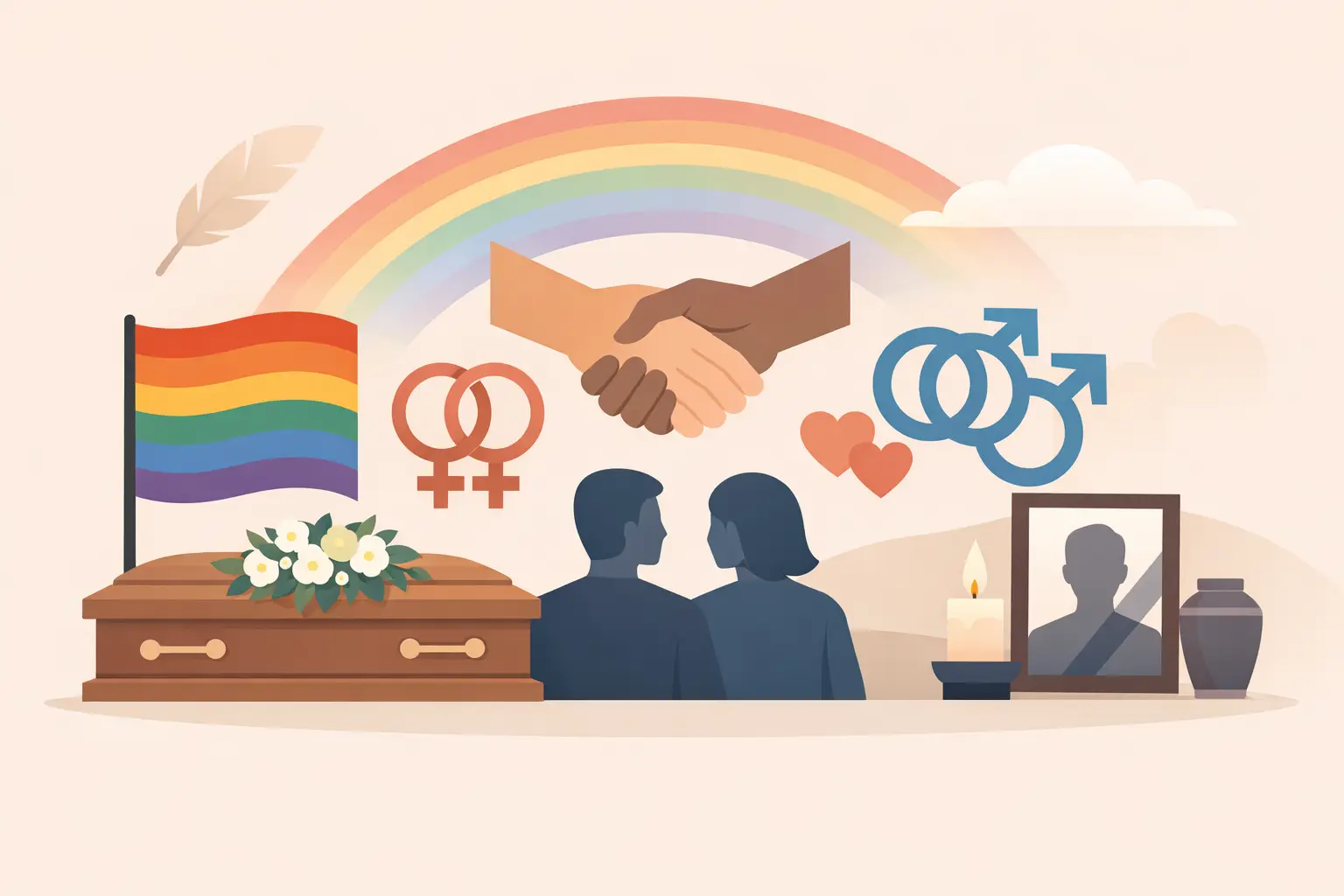
What LGBTQ Inclusive Funeral Services Mean
A funeral can be the first moment when a person’s life is spoken about in full – or quietly edited by others. For LGBTQ+ people and those who love them, that difference matters deeply.
When families ask about LGBTQ inclusive funeral services, they are often asking something more personal than a checklist. They want to know whether the funeral director will respect a partner without question, use the right name and pronouns, understand chosen family, and create a service that feels truthful. At a time when emotions are already raw, nobody should have to fight to have a loved one recognised properly.
What LGBTQ inclusive funeral services really involve
At the heart of LGBTQ inclusive funeral services is a simple principle: the funeral should reflect the person who has died, not other people’s discomfort, assumptions or omissions.
That can shape every part of the arrangements. It may mean ensuring a spouse, civil partner or long-term partner is acknowledged correctly in notices and speeches. It may mean recognising the role of close friends, ex-partners or chosen family members who were central in the person’s life. It may mean taking care over language in the order of service, obituary, chapel announcements and memorial keepsakes.
For some families, inclusion is most visible in the ceremony itself. A celebrant may speak openly about a same-sex relationship, a trans person’s identity, or a life lived with courage in the face of prejudice. For others, it is quieter but no less important – private conversations handled with sensitivity, staff who do not make awkward assumptions, and arrangements made without anyone having to explain themselves repeatedly.
Why this matters so much in funeral planning
Grief often magnifies family tensions. If relationships were strained in life, they can become more difficult after a death. LGBTQ+ bereavement can carry extra pressures, especially where relatives did not fully accept the person’s identity, partner or way of life.
That is one reason LGBTQ inclusive funeral services are not a niche extra. They are part of good, careful funeral care. A funeral director should be able to guide families through sensitive situations with dignity while keeping the focus on the person who has died.
Sometimes the challenge is legal and practical. The person with the legal right to arrange the funeral may not be the person closest to the deceased emotionally. Sometimes there is broad agreement, but uncertainty about wording, music, readings or who should be included. Sometimes a family wants a traditional religious funeral while a partner or close friends want the service to reflect the person’s identity more openly. There is no single formula. What matters is honest conversation, respect and experienced guidance.
LGBTQ inclusive funeral services and the details that shape a service
The most meaningful decisions are often the smallest ones. Getting the correct name and pronouns right is one of them. If a person was transgender or non-binary, the way they are referred to throughout the funeral can either affirm who they were or cause deep hurt.
Photographs are another area that deserves thought. Some families want to include images from across the person’s life. Others may prefer to focus on photographs that reflect how the person wished to be seen. There can be sensitive judgement involved here, especially if family members hold different views. A good funeral director will not rush that conversation.
Music, readings and speakers can also make a funeral feel more authentic. A service might include a favourite song from a Pride event, a reading that speaks to love and resilience, or words from a friend who knew the deceased in a way relatives did not. Equally, some people want a very traditional service with subtle personal touches rather than overt references to identity. Both approaches can be right. It depends on the person, the family and the tone they would have wanted.
When family structures are more complex
Many LGBTQ+ people build families in ways that do not fit neat assumptions. A chosen family may include friends who became carers, former partners who remained close, neighbours who were present every day, or community members who offered belonging over many years.
In funeral planning, these relationships should not be treated as secondary simply because they are not immediately visible on official paperwork. Legal next of kin and emotional closeness do not always line up neatly. That can be painful, particularly if someone who shared a home or life with the deceased feels overlooked.
An experienced funeral director can help create space for the right people to be involved, even when formal responsibilities sit elsewhere. That may mean careful mediation around attendance, tribute writing, coffin bearers, floral tributes or who speaks during the service. Not every disagreement can be solved fully, but many can be handled more gently when expectations are addressed early.
Faith, culture and inclusion can sit together
One concern families sometimes raise is whether an inclusive funeral can still feel religious, traditional or culturally appropriate. In many cases, yes.
LGBTQ inclusive funeral services do not require a family to abandon faith, ritual or heritage. They ask whether those elements can be handled in a way that remains respectful to the deceased and to those mourning them. For some, that means finding clergy or celebrants who can lead with compassion. For others, it means shaping a non-religious service that still honours family customs, language, dress or music.
There can be trade-offs. A family may choose a church service but keep some tributes more personal at the wake. They may decide on a crematorium ceremony with religious readings rather than a fully faith-led funeral. What matters is not forcing a perfect ideological answer at a difficult time, but creating something honest, dignified and workable.
What to ask a funeral director
If you are arranging a funeral and want reassurance, it is reasonable to ask direct questions. You might want to know whether the team has experience supporting LGBTQ+ families, how they handle names and pronouns in official and ceremonial materials, and whether they are comfortable navigating complex family situations.
You may also want clarity on practical matters. Can they help with notices, flowers, vehicles, chapel of rest arrangements and memorial choices in a way that reflects the person fully? Will they explain costs clearly from the outset? If there is urgency after a death, can you contact them at any hour?
These are not awkward questions. They are sensible ones. Funeral planning is emotional, but it is also practical. Sensitivity matters most when it is backed by competent day-to-day handling.
A local service should feel personal, not procedural
For families across Catford and the wider South London area, the difference between a corporate process and personal care is often felt straight away. You should not have to repeat painful information to multiple people or worry that important details will be lost between departments.
A director-led, community-rooted service can make these conversations easier. It allows for continuity, accountability and a clearer sense that the funeral is being shaped around the person, not slotted into a standard package. That includes being transparent about pricing and explaining options plainly, whether the family chooses burial, cremation, a memorial service, a simple ceremony or something more bespoke.
At Adrian Moore Funerals, that approach means supporting families every step of the way with dignity, care and clear guidance, including when a funeral needs to reflect LGBTQ+ identity and relationships with proper respect.
Making space for truth in a difficult moment
The best funerals do not perform perfection. They create room for truth, grief and love to sit together.
For LGBTQ+ people, that truth may include a partner who stood by them for decades, a chosen name that mattered greatly, friendships that became family, or a life that was not always easy but was still fully their own. A funeral should be able to hold that without hesitation.
If you are arranging a service now, it is enough to start with what you know: who this person was, who mattered to them, and how they would have wanted to be remembered. The right support can help with the rest. And if you need guidance urgently, contact us anytime of the day or night.
