
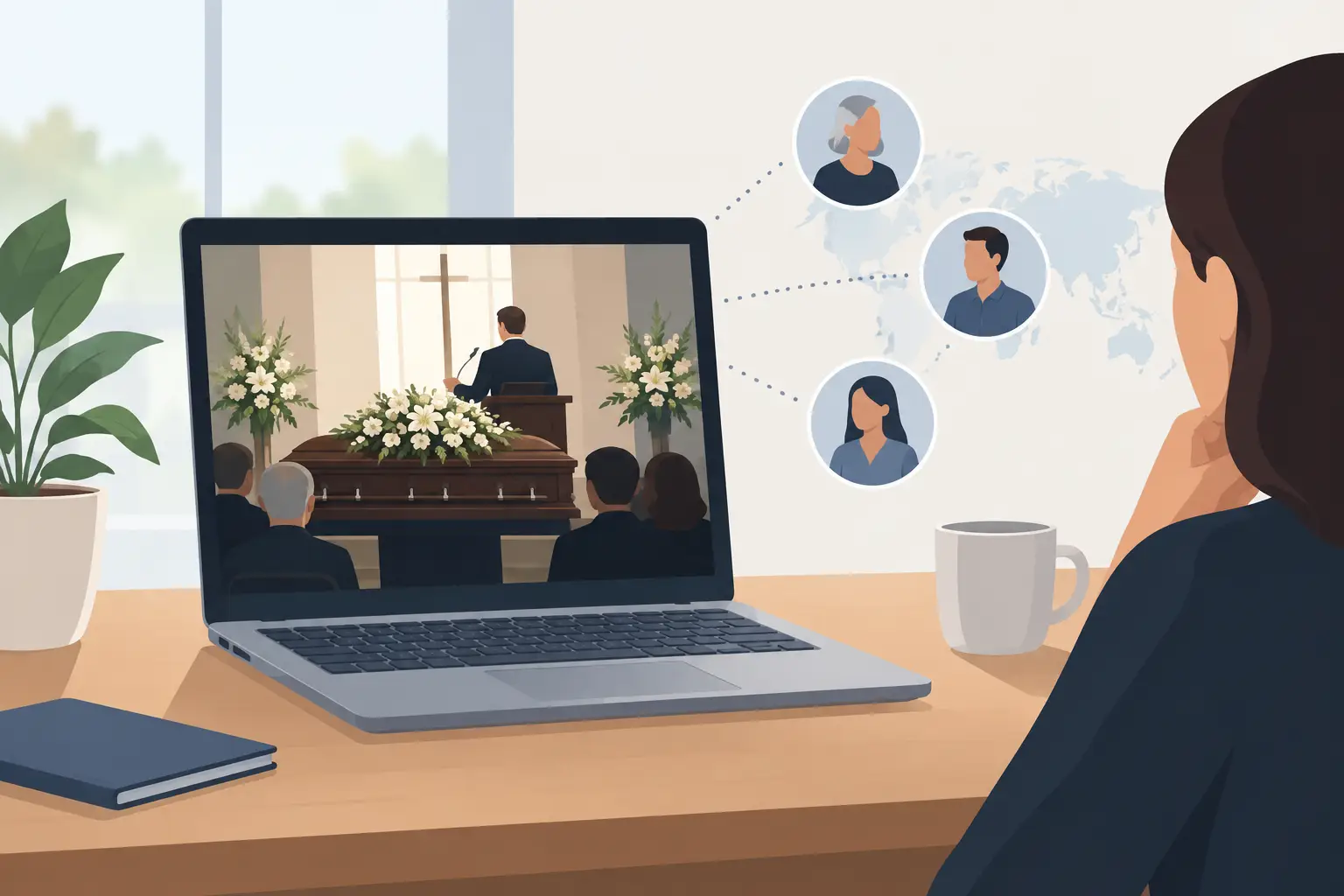
A Funeral Webcast for Relatives Who Cannot Attend
When someone important dies, being unable to attend their funeral can add another layer of sadness. A relative may be unwell, living abroad, caring for young children or unable to travel at short notice. A funeral webcast for relatives gives those people a respectful way to be present for the service, even when they cannot be in the room.
It is not a replacement for sitting beside family, sharing a hymn or offering a hand after the committal. It can, however, mean that a son overseas hears the eulogy, a friend in hospital can say goodbye, or a grandchild away at university can feel included. When planned thoughtfully, a webcast becomes one more way of gathering people around the person who has died.
What is a funeral webcast for relatives?
A funeral webcast is a live video transmission of a funeral, cremation or memorial service. Relatives receive details to watch online from home or wherever they are able to be. Depending on the venue, the service may also be recorded so that those who could not watch live can view it afterwards within an agreed period.
Many crematoria now have their own professional webcast systems, with discreet fixed cameras and staff who operate the service. Some churches and ceremony venues can provide similar arrangements. Where a family is holding a service elsewhere, it may be possible to arrange a professional videographer, although this needs careful consideration around the setting, permissions and cost.
The right option depends on the venue, the type of ceremony and how many people need access. A quiet graveside farewell may not be suitable for filming, particularly in poor weather or where privacy is a concern. A chapel service with a fixed camera may be straightforward. There is no expectation that every funeral should be broadcast. It is simply an option for families who feel it would bring comfort.
Deciding whether a webcast feels right
The decision should begin with the wishes of the person who has died, where these are known, and with the immediate family’s comfort. Some people would have welcomed distant friends and relatives being included. Others may have preferred a more private farewell. Both choices deserve respect.
It can help to think about who would benefit most. Perhaps close family members live in another country, or a relative is too frail to manage the journey to Catford, Lewisham, Bromley or elsewhere in South London. In those circumstances, a webcast can reduce the pressure on people who are already coping with illness, caring duties, financial constraints or complicated travel arrangements.
A webcast also gives family members an opportunity to choose their level of involvement. They may watch quietly on their own, or several relatives may gather together at a home abroad. Some families arrange a small moment afterwards, such as lighting a candle, sharing memories or raising a glass in remembrance. That can be particularly meaningful when time zones prevent someone from joining a wake or reception in person.
Privacy matters as much as access
A funeral is a personal occasion, not a public event. The safest arrangements use a private viewing link, password protection or individual access details supplied only to invited guests. Avoid sharing access details on social media or in a public funeral notice unless the family has consciously chosen an open service.
Before the day, decide who will receive the link and appoint one family member to pass on updates. This prevents conflicting messages and allows the organiser to keep a clear record of those invited. If the service includes readings, music or tributes from people who may not wish to appear on camera, tell the funeral director or venue in advance.
It is also worth asking what happens to the recording. Find out whether it will be available after the service, how long it will be stored, whether it can be downloaded, and who can request access. Some venues retain recordings only for a limited period. Others offer a keepsake copy for an additional charge. Clear answers in advance spare the family another decision when emotions are running high.
Music and readings may affect the recording
Families are often surprised to learn that copyright rules can affect music played during an online broadcast. A venue may need to mute or replace parts of a recorded service where commercial music has been used. The live broadcast may also be subject to particular restrictions.
This does not mean you cannot choose meaningful music. It simply means it is sensible to ask early how the venue handles it. A funeral director can help you understand the available options, whether that means choosing music supplied through the crematorium system, accepting that a section may be muted on the replay, or arranging a different form of tribute.
Planning the practical details with care
Once you have chosen a webcast, ensure the venue and funeral director know as soon as possible. Availability can vary, and some venues need the booking confirmed several working days before the service. Giving notice also allows time to test the arrangement and send instructions to relatives.
The most useful information for viewers is simple: the date, start time, viewing link, password if required, and a contact number for the person coordinating the family. Include the time zone for anyone watching from overseas. It is kind to suggest that viewers log in ten or fifteen minutes early, as they may need to enter a code or update their browser.
On the day, choose one trusted person who is not carrying the main responsibility for the funeral to deal with technical questions. They can send a reminder, answer calls from relatives who cannot find the link, and let people know if the service is running slightly late. This small role can protect the closest family from avoidable interruptions.
Ask the venue what will be shown before and after the service. Some systems display a holding screen; others show the chapel as guests arrive. Families may prefer the camera to begin only once the service starts. You can also ask whether the committal, burial or any family-only portion will be included. There is no single correct choice, only what feels appropriate for your family.
Supporting relatives who are watching from afar
Watching a funeral alone can feel unexpectedly intense. If possible, call a close relative before the service to check they have the details and know who to contact if technology causes a problem. Afterwards, a message or phone call can make a real difference, especially for someone who has been unable to travel because of poor health or distance.
For older relatives, keep the instructions short and practical. They may need help opening an email, entering a password or connecting a laptop to a television. A neighbour, friend or another family member may be able to sit with them. Do not assume that everyone has a reliable internet connection either. In some cases, a recording viewed later with support is less stressful than trying to watch live.
A webcast can also support relatives who need time before they can face the service. Grief is not orderly, and attendance is not a measure of love. Offering a recording, where available, lets people say goodbye in their own space and at a time they can manage.
Costs and questions to raise
Webcast fees vary between crematoria, churches, venues and professional filming providers. Some have a standard charge for a live stream, while others price live viewing and a recording separately. It is reasonable to ask for the cost clearly before confirming the arrangement, alongside any charges for a downloadable copy or extended access.
When discussing the service, ask whether the webcast is operated by venue staff, whether there is a backup plan if there is a technical fault, and whether the venue can provide a test link. You may also want to ask where cameras are positioned and whether mourners will be visible. These details can reassure relatives who value a more discreet service.
At Adrian Moore Funerals, we can discuss the available webcast arrangements with your chosen venue as part of planning the funeral, helping you understand what is possible and what it will cost. We will also make sure the practical arrangements fit the character of the ceremony, whether it is religious, non-religious, LGBTQ+ inclusive or shaped around particular family traditions.
A funeral webcast for relatives is ultimately about connection, not technology. When travel is impossible, a carefully arranged broadcast can give people a place in the farewell and a shared moment to remember someone they love. If you are arranging a funeral and are unsure whether it is right for your family, ask for guidance. A calm conversation can make the decision feel much clearer.
