
Funeral Service for Non Religious Family
When a family is not religious, one of the first worries is often whether the funeral will feel empty or unfamiliar. In practice, a funeral service for non religious family can be deeply personal, thoughtful and moving – often because it is built around the person themselves rather than a fixed format.
For many families across Catford and South London, this is new ground. You may know what you do not want, but still feel unsure about what should take its place. That is completely understandable. A non-religious funeral does not mean a cold or formal occasion. It simply means the service is shaped by your loved one’s life, values, relationships and wishes.
What a funeral service for non religious family can look like
A non-religious funeral usually keeps the same core purpose as any other funeral. It gives people a clear moment to gather, to acknowledge the death, to remember the person who has died and to begin saying goodbye. What changes is the language, tone and structure of the ceremony.
Some families prefer a simple committal with a few words and a favourite piece of music. Others want a fuller service led by a civil celebrant, with tributes, readings and a period of reflection. There is no single correct model. The right choice depends on the personality of the person who has died, the views of the people attending and how formal or informal the family wants the day to feel.
In many cases, a celebrant-led service works well because it provides gentle guidance without introducing religious content that does not feel authentic. A skilled celebrant can help create something warm and dignified, while keeping the focus on the individual rather than on ritual for its own sake.
Choosing the right tone
One of the most helpful questions to ask is this: what would have felt right for them?
For some people, that means quiet, restrained and understated. For others, it means a room full of stories, favourite songs and honest laughter alongside tears. A funeral does not have to be sombre from beginning to end in order to be respectful. Equally, it does not have to become overly informal to avoid religion. Most families want a balance – heartfelt but steady, personal but well organised.
That balance matters. If the ceremony becomes too sparse, it can feel abrupt. If it tries to do too much, it can feel overwhelming, especially on a difficult day. The best services usually have a clear shape and enough time for reflection, without becoming drawn out.
Who can lead a non-religious funeral service?
If you are arranging a funeral service for non religious family, you generally have a few options. A civil celebrant is often the most popular choice because they are experienced in writing and conducting personalised ceremonies. They will usually meet with the family, learn about the person’s life and prepare a service that reflects them accurately.
Some families ask a funeral director to guide a simple service, especially if they want only a few spoken words before the committal. Others choose to have a family member or close friend speak. That can be very powerful, but it is worth being realistic. Grief can make public speaking harder than expected, so many families prefer to share readings or tributes while a celebrant holds the structure together.
There is also the option of separating the formal funeral from the wider celebration of life. For example, the crematorium service may be short and simple, followed later by a memorial gathering where more people can speak freely. This can be helpful where time restrictions apply or where family members want a more relaxed setting afterwards.
Building the ceremony around the person
The strongest non-religious services tend to be specific. Rather than reaching for general statements about love or loss, they draw on the details that made that person recognisable to everyone in the room.
That may include the work they were proud of, the way they cared for others, the music they always played, the places they loved, or the humour people will miss. Even small details matter. A gardener, a bus driver, a teacher, a devoted grandparent, a friend who never missed a birthday – these are the things that give a ceremony truth.
Music often carries a great deal of emotional weight in a non-religious funeral. Some families choose classical pieces or instrumental music. Others choose songs that meant something to their loved one, even if they are unexpected. The only real question is whether the choice feels fitting in the room. A favourite song can be comforting, but if it risks feeling jarring at a very raw moment, it may work better at the end of the service or at the wake.
Readings can also help shape the tone. These do not need to be religious. Poems, letters, song lyrics, short extracts from literature, or words written by the family can all work beautifully. The best reading is usually one that sounds genuine in that person’s voice or reflects the way they lived.
Practical choices that affect the day
There are a number of practical decisions that shape how the service feels. Venue is one of the most important. A crematorium chapel is often the simplest option because everything is arranged in one place, but some families prefer a cemetery chapel, a village hall, a community venue or another meaningful setting for a memorial service.
The order of service is another point to consider. Printed orders can be useful, especially for older relatives or guests who may feel more comfortable knowing what to expect. They also become keepsakes. At the same time, not every family wants them, and a simpler service may not need formal printing.
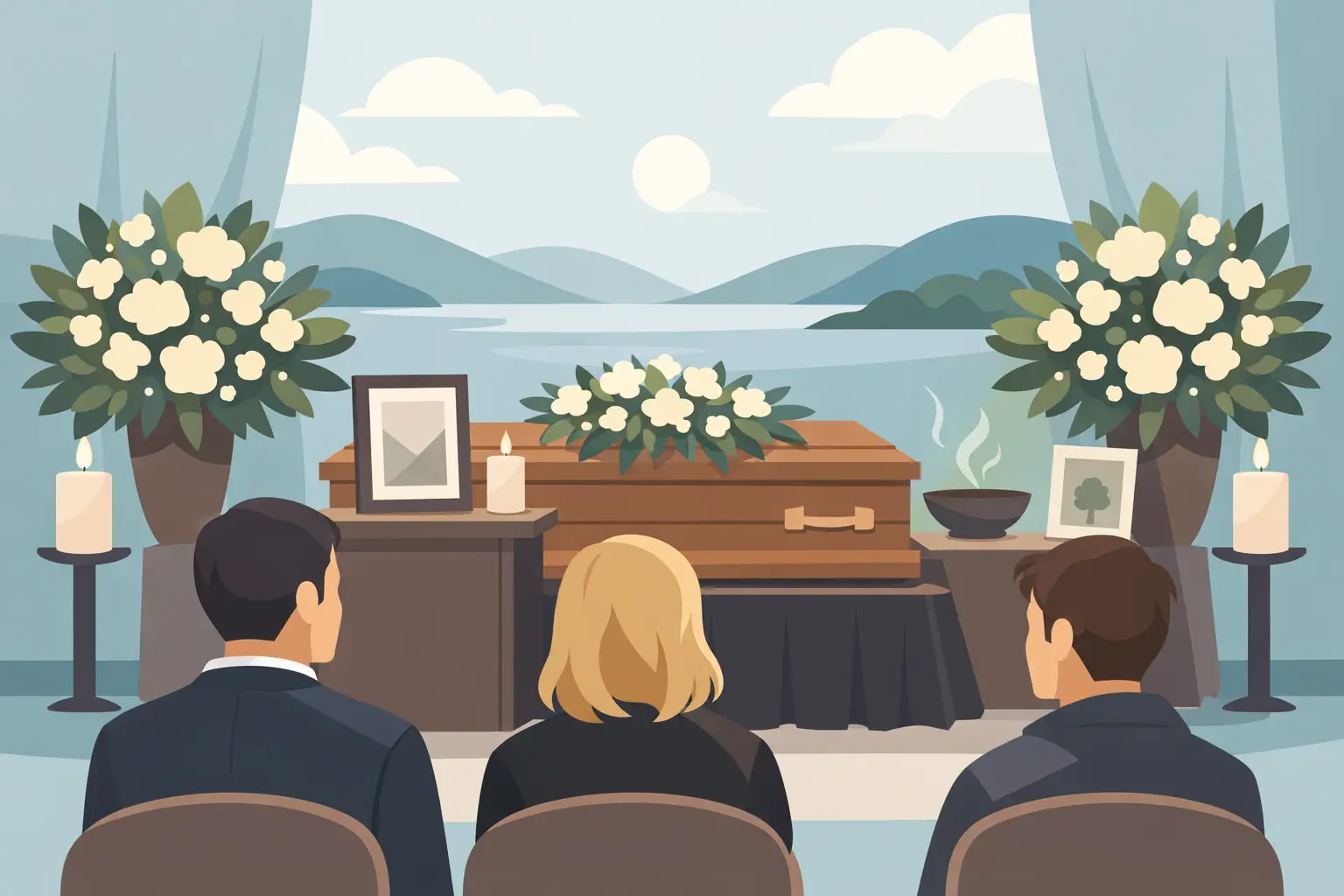
Visual touches can make a great difference without becoming elaborate. Photographs, flowers, a chosen colour palette or a table with personal items can all help create a sense of presence. For environmentally minded families, there may also be eco-friendly choices around coffins, flowers and transport. These decisions are personal, and they do not all carry the same cost, so it helps to talk through what matters most.
When families have mixed beliefs
This is one of the most common situations, and it needs careful handling. The person who has died may not have been religious, while some relatives are. Or the family may include people with different faiths, alongside those with none at all.
In those cases, a measured approach usually works best. A non-religious service can still include a quiet moment of reflection that allows people to pray privately if they wish. It may include a traditional hymn if it carries strong family meaning, even where the overall service is secular. What matters is honesty. Including religious elements purely to avoid awkwardness can feel uncomfortable, but excluding every trace of tradition can also upset relatives who are grieving.
This is where good guidance is valuable. Often, there is a middle ground that respects the person who has died without creating unnecessary tension for the people left behind.
Cost, clarity and avoiding pressure
Families arranging funerals are often making decisions while tired, shocked and under time pressure. For that reason, clarity matters. A non-religious funeral is not automatically cheaper or more expensive than a religious one. Cost usually depends more on the type of funeral, the venue, the coffin, vehicles, flowers, notices and whether the service is simple or more bespoke.
It is sensible to ask for itemised pricing and clear explanations of what is included. Some families want a straightforward unattended or very simple cremation, followed by a separate memorial. Others want a fully attended ceremony with all the practical arrangements managed on their behalf. Neither choice is more caring than the other. It depends on budget, wishes and what will help the family cope.
A good funeral director should make those options plain, without pressure or unnecessary complication. At Adrian Moore Funerals, that means helping families create a service that feels right for the person, while being transparent about costs and practicalities every step of the way.
Giving people something real to hold onto
The fear many families have is that a secular funeral will feel like a blank space where tradition used to be. In reality, the opposite is often true. When it is done with care, a non-religious service gives mourners something real to hold onto – the sound of a familiar song, the truth of a well-told tribute, the comfort of gathering with people who knew and loved the same person.
If you are arranging a funeral now, you do not need to have every answer at once. Start with the person. What mattered to them, what would have suited them, and what would help the people closest to them say goodbye with honesty and peace? From there, the right shape of the service usually begins to emerge.
If you need guidance, ask for it. A steady hand can make all the difference, especially in the first few days, and support is there any time of the day or night.
