
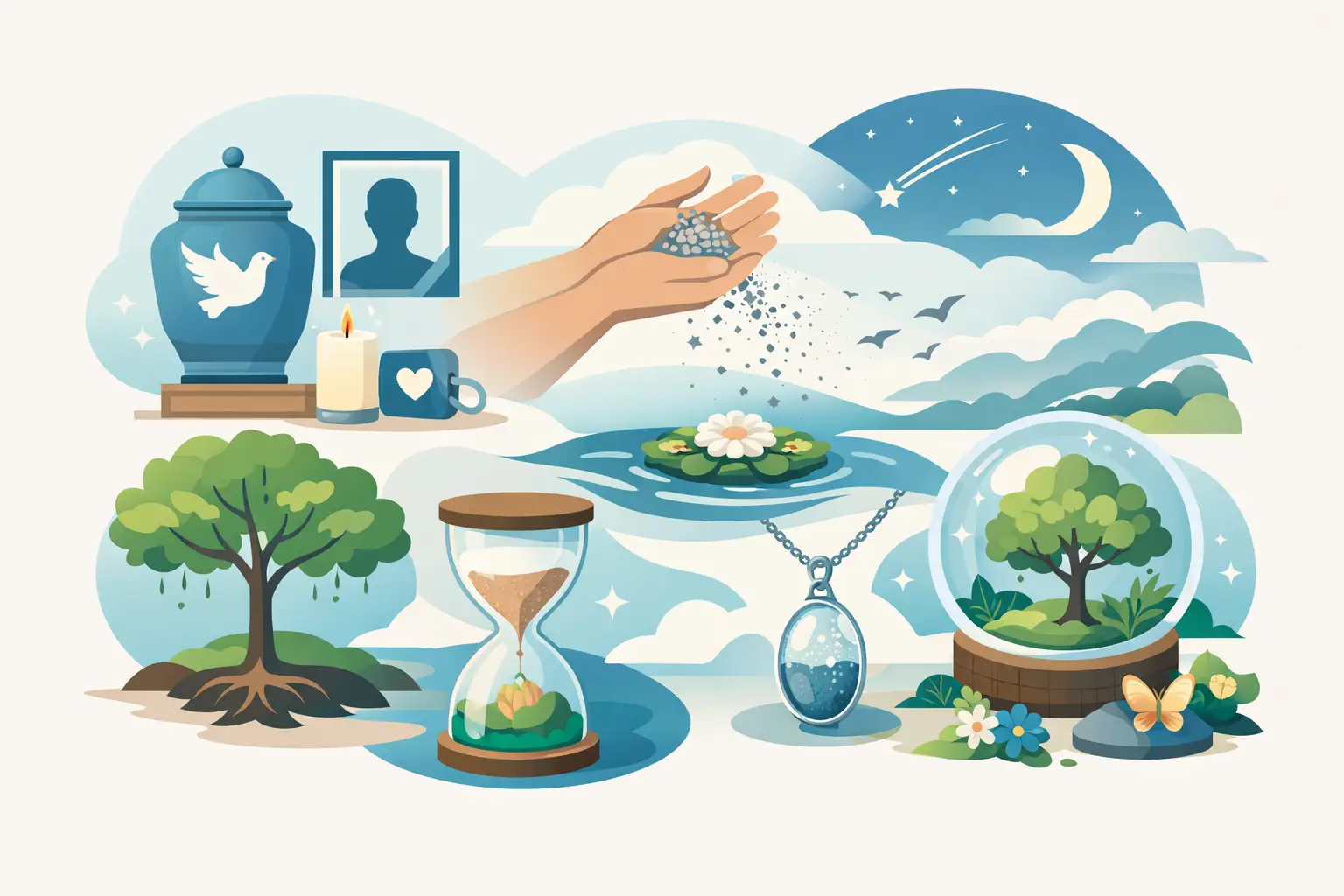
12 Best Memorial Ideas After Cremation
Some families know straight away what feels right after a cremation. Others reach that point weeks or months later, once the paperwork is done and the quieter part of grief begins. If you are considering the best memorial ideas after cremation, it often helps to think less about what is traditional and more about what would feel true to the person you are remembering.
There is no single correct choice. A memorial can be public or private, permanent or simple, faith-based or non-religious. What matters is that it gives family and friends somewhere to place their love, their memories, and, very often, their grief.
Choosing the best memorial ideas after cremation
The right memorial usually sits at the meeting point of three things – the wishes of the person who has died, the needs of the family, and the practical realities of budget, location, and upkeep. A beautiful idea can become difficult if relatives live far apart, if ongoing maintenance is likely to fall to one person, or if there is uncertainty about where ashes may be kept or scattered.
That is why it can help to pause before making a final decision. Some families choose to keep ashes at home for a time while they decide. Others prefer to arrange something quickly because having a plan brings comfort. Both approaches are perfectly reasonable.
A permanent memorial in a cemetery or crematorium
For many families, a fixed place to visit matters more than anything else. A memorial plaque, kerbstone, or niche at a cemetery or crematorium gives structure to remembrance. There is somewhere to take flowers on a birthday, somewhere grandchildren can visit, and somewhere that feels established rather than temporary.
This option often suits families who are spread across South London and want a clear, shared focal point. It can also be helpful after a direct cremation, where there may not have been a formal service at the time. The memorial then becomes the place where remembrance settles.
The main consideration is upkeep and cost. Some memorials involve a one-off fee, while others include lease periods or maintenance charges. Rules also vary from one cemetery or crematorium to another, especially around materials, size, and decoration.
Scattering ashes in a meaningful place
Scattering remains one of the most personal memorial choices. It may be a favourite garden, a river path, a football ground with permission, or a stretch of countryside that mattered to the person who has died. When it is handled thoughtfully, it can feel gentle and deeply fitting.
What families sometimes underestimate is the emotional finality. For some people, scattering brings peace. For others, it can feel harder than expected because there is no longer a physical place connected to the ashes. A simple way around that is to combine scattering with another tribute, such as a bench plaque, memorial stone, or annual gathering.
It is also important to check permissions in advance. Not every location allows ashes to be scattered freely, and guidance can differ depending on whether the land is private, council-managed, or environmentally protected.
Keeping ashes in the home
Keeping ashes at home is more common than many people realise. For some families, this feels natural. A carefully chosen urn placed in a quiet, respectful part of the home can be comforting, especially in the first year after a loss.
This can also be a good choice if relatives are not yet ready to make a permanent decision. There is no need to rush because others expect a certain timeline. Grief rarely works neatly.
That said, it helps to think ahead. If ashes are kept at home, who will eventually take responsibility for them? Is everyone in the household comfortable with the arrangement? A temporary choice can become long term without anyone ever properly discussing it, so a gentle family conversation is often worthwhile.
Memorial jewellery and keepsakes
When people ask about the best memorial ideas after cremation, jewellery often comes up because it is private, portable, and personal. A small amount of ashes can be placed within a pendant, ring, bracelet, or charm. Some families also choose keepsake items such as glass ornaments, small urns, or framed memorial pieces.
This type of memorial suits people who draw comfort from closeness. It can be especially meaningful where ashes are shared between relatives, allowing each person to remember in their own way rather than relying on a single collective decision.
The trade-off is that tastes differ. One family member may find memorial jewellery deeply comforting, while another may feel it is not for them at all. That is perfectly fine. A memorial does not need to be the same for everyone.
Planting a tree or creating a living memorial
A living memorial can feel hopeful without being overly formal. Planting a tree, rose bush, or part of a garden in someone’s memory gives families something that grows and changes over time. It can be a particularly meaningful choice for those who valued nature, gardening, or eco-friendly funeral options.
Some families use ashes within a biodegradable planting system, while others prefer simply to dedicate a tree or garden area without involving the ashes directly. Both approaches can work well.
The practical point here is permanence. Gardens change, people move house, and not every tree survives. If the aim is to create a lifelong public place of remembrance, a cemetery or crematorium memorial may be more dependable. If the aim is something intimate and life-affirming, a living tribute can be very special.
A memorial bench or plaque
A bench or plaque offers a simple public tribute that does not feel too imposing. It can sit in a park, at a sports club, within a place of worship, or in another community setting that held meaning. Families often appreciate the quiet usefulness of this kind of memorial. It creates a place to pause rather than a place that demands ceremony.
As with scattering, permission and local policy matter. Not every council or venue accepts new benches or plaques, and there are often waiting lists, design standards, and fixed terms. Still, where available, this can be one of the most thoughtful options for a person who was rooted in their local community.
A memorial service held later
Not every goodbye happens on the day of the cremation. Sometimes the most appropriate memorial is a separate service held weeks or months afterwards, once family can travel, emotions are less raw, or cultural and religious needs can be properly met.
This can take place in a church, a function room, a garden, or at home. It may include music, readings, photographs, and shared stories. For families who felt they had to make quick decisions at the time of death, a later memorial can provide the space they did not have earlier.
This approach is often especially helpful where relatives live abroad or where there are different beliefs within the family. It allows room for a more inclusive and considered tribute.
Dividing ashes between family members
For some families, sharing ashes feels right. This may mean several keepsake urns, jewellery pieces, or a small portion reserved for scattering while the rest is placed elsewhere. It can reduce tension when relatives have different needs and live in different places.
It is worth saying that this is not right for every family. Some find it comforting, while others feel strongly that ashes should remain together. If there are differing views, careful discussion matters more than speed. A memorial choice should not create lasting hurt where a little patience could have avoided it.
Creating a tribute through words, music, or ritual
Not every memorial needs to centre on ashes. Sometimes the most lasting tribute is an annual act of remembrance – a favourite meal cooked on a birthday, a donation collection at Christmas, a family walk, or a piece of music played each year. These rituals can sit alongside a physical memorial or stand on their own.
This can be particularly meaningful for families who do not want a formal marker, or for those whose loved one would have preferred simplicity. In practice, these quieter traditions often become the memorial that people carry most faithfully.
How to decide what is right for your family
If you are weighing up the best memorial ideas after cremation, it helps to ask a few steady questions. Did the person leave clear wishes? Will family members want a place to visit? Is this meant to be private, shared, or public? What level of cost and upkeep feels manageable, not just now but years from now?
It can also help to separate what feels meaningful from what feels expected. Families sometimes choose a memorial because they think they ought to, then later realise another option would have suited them better. There is no prize for doing grief in the most conventional way.
A good funeral director can talk through these options carefully, including what is possible locally, what permissions may be needed, and how costs are likely to work. At Adrian Moore Funerals, that guidance is always rooted in the understanding that each family, each belief system, and each budget deserves the same care and respect.
The best memorial is rarely the grandest one. More often, it is the one that feels unmistakably like them, and gives you somewhere gentle to place your remembrance in the years ahead.
