
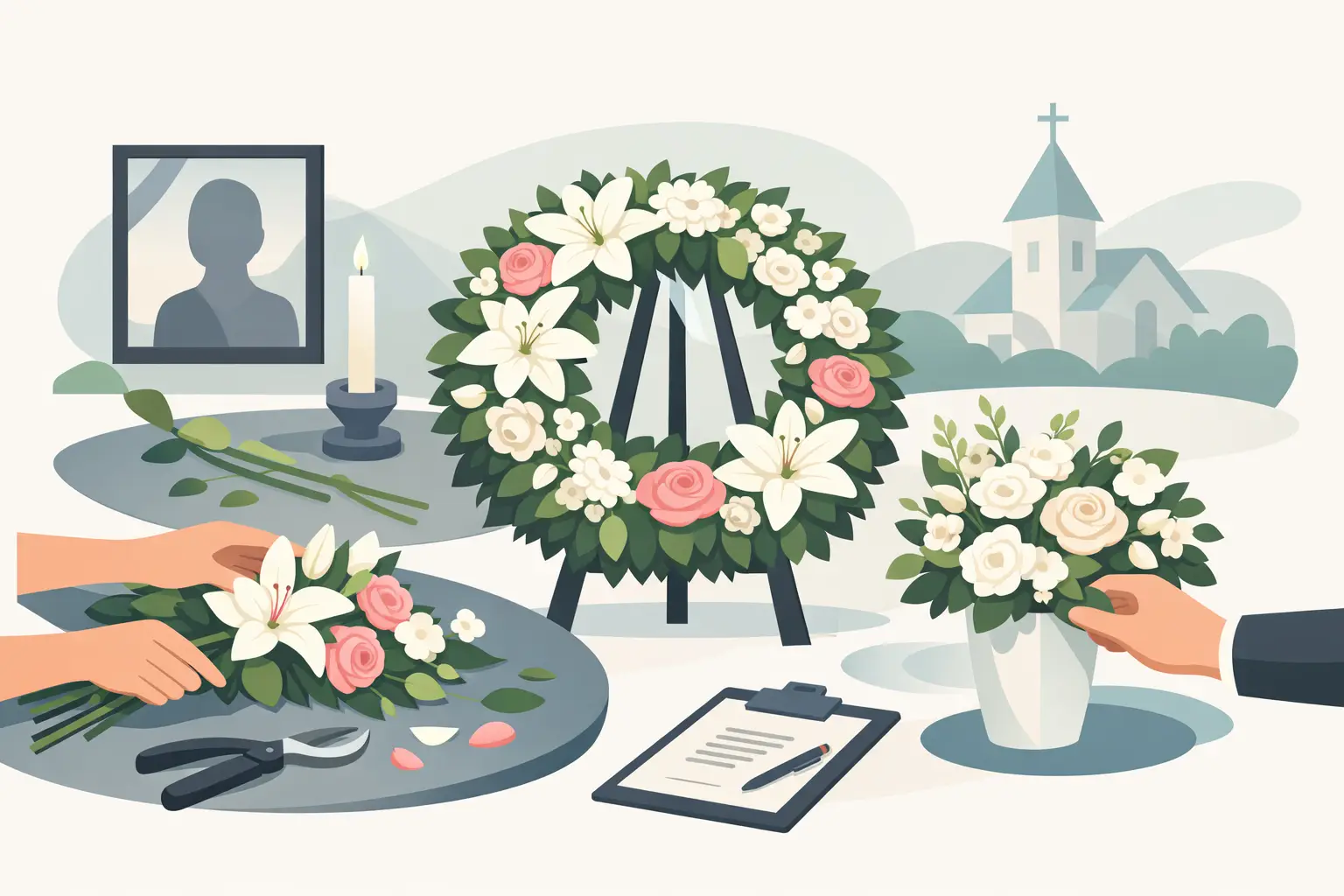
How to Organise Funeral Flowers
When a family asks how to organise funeral flowers, they are rarely just asking about bouquets and wreaths. They are often trying to make one more thoughtful decision while coping with shock, grief and a long list of practical arrangements. Flowers can bring comfort, add meaning to the service and reflect someone’s character, but they should never feel like another burden.
In most cases, the best approach is to keep things simple, decide early who is coordinating the floral tributes, and choose arrangements that feel appropriate for the person being remembered. That may mean a single coffin spray from immediate family, a few hand-tied stems from grandchildren, or no flowers at all in favour of donations. There is no single right answer. What matters is that the choice sits comfortably with the family, the budget and the tone of the funeral.
How to organise funeral flowers without added stress
One of the first decisions is whether flowers are wanted at all. Some families feel strongly that floral tributes are an important part of the farewell. Others prefer a more understated service, or ask for charitable donations instead. If the person who has died left wishes, those should guide the decision where possible.
Once that is clear, it helps to nominate one person to coordinate. This avoids duplicate orders, confusion over colours or wording, and the awkwardness of several relatives trying to make the same decision at once. In many families this will be the next of kin, but it can just as easily be a sibling, adult child or close friend who is comfortable handling the detail.
That person can then confirm a few basics with the funeral director and florist. These usually include the date, time and location of the funeral, whether the service is at a crematorium, cemetery or place of worship, and when flowers need to be delivered. Some venues have practical limits on space, and some cemeteries have their own guidance on what may be left graveside.
Decide what role the flowers will play
Funeral flowers can do different jobs. For some families, they are the main visual tribute, placed on top of the coffin or around it. For others, they are a quieter addition that softens the room without becoming the focus. Thinking about their role makes the next decisions easier.
A coffin spray is often chosen by the closest family and placed directly on the coffin. This is usually the central arrangement and may be the only formal tribute if the family wants a simple look. Wreaths and posies are also common, especially from extended family, friends, neighbours or clubs. Letter tributes, shaped arrangements and more personalised pieces can be very meaningful, but they are not right for every service. A traditional church funeral may call for restraint, while a more celebratory service may welcome colour and individuality.
This is where it helps to think about the person rather than what is expected. A keen gardener may be better represented by seasonal flowers and natural textures than by a formal design. Someone known for bright clothing or a cheerful home might suit more colour than the usual white and green. Equally, a modest and private person may have preferred something understated.
Choosing flowers that feel personal
Families often worry about getting this wrong, but personal does not have to mean elaborate. Favourite flowers, a meaningful colour, or a style that reflects the person’s tastes is often enough. Roses, lilies, chrysanthemums and carnations remain common choices because they work well in funeral arrangements and hold up reliably, but they are not the only options.
Seasonal flowers can be a thoughtful and cost-conscious choice. They often look more natural and may suit eco-friendly funerals better than heavily structured tributes. If sustainability matters to the family, it is worth asking about foam-free designs, locally grown flowers and arrangements that can be composted more easily afterwards.
For some families, religious or cultural customs will shape the decision. Others may want flowers that reflect an LGBTQ+ inclusive service or a ceremony centred on a chosen family rather than traditional family roles. Good planning should leave room for that. The flowers should support the farewell you are creating, not force it into a standard pattern.
Be clear about budget from the start
Cost is one of the reasons families hesitate over funeral flowers, and understandably so. Funeral expenses add up quickly. Being open about budget from the beginning is not insensitive. It is practical, and it allows the florist to suggest suitable options without anyone feeling uncomfortable later.
A single larger tribute can sometimes have more impact than several smaller ones. Equally, if different branches of the family want to contribute, it may be easier to collect towards one main arrangement rather than placing multiple separate orders. There is no need to spend heavily for the tribute to be dignified.
If many people are asking what they can send, the family may wish to include guidance in the funeral notice or service information. That could mean family flowers only, flowers welcome, or donations instead of flowers. Clear wording prevents uncertainty and helps people show support in a way the family is comfortable with.
Family flowers only or flowers from everyone?
This decision often comes down to space, preference and practicality. At some services, especially smaller chapel or crematorium services, too many arrangements can become difficult to manage. In other cases, families draw comfort from seeing tributes from neighbours, work colleagues and community groups.
If the family chooses flowers from immediate family only, that is entirely acceptable. If they welcome wider tributes, it still helps to set expectations. A funeral director can often advise on what the venue can accommodate and how flowers will be positioned on the day.
Timing matters more than people realise
One of the most practical parts of how to organise funeral flowers is timing. Flowers are perishable, and funeral schedules are fixed. Ordering late can limit choice and create unnecessary worry.
As a general rule, it is sensible to arrange flowers as soon as the funeral date and time are confirmed. That gives the florist enough notice to source particular flowers, prepare larger tributes and coordinate delivery. If the funeral is taking place quickly, a simpler design may be the safest option.
You will also need to confirm where the flowers should go. Sometimes they are delivered directly to the funeral director, sometimes to the service venue, and occasionally to the family home if relatives want to travel with them. What matters most is that everyone involved has the same instructions.
Don’t overlook the message cards
The small card attached to a tribute is easy to leave until the last minute, yet it often carries great emotional weight. A brief message is enough. It does not need to be literary or polished. Simple wording such as “With love always”, “In loving memory”, or “From your loving family” is often more than enough.
If children or grandchildren want to be included, that can be especially meaningful. The wording should reflect the relationship honestly. Formal language is not always best. Warmth and sincerity matter more.
Check spellings carefully, particularly for named tributes and cards from several people. In the pressure of funeral planning, small errors happen easily.
What happens to funeral flowers afterwards?
This is worth considering in advance, because families are sometimes asked on the day and have not had time to think about it. Some flowers go with the coffin for burial or cremation, depending on the service and the materials used in the tribute. Others may be taken to the grave, left at a memorial, brought home, or donated to a care home or local community setting if suitable.
If the funeral is a cremation, some families like to take a few stems home afterwards. Others prefer the funeral director to manage the arrangements. If sustainability matters, ask what can be reused, composted or disposed of responsibly. Floral foam, plastic wrapping and certain accessories may need separate handling.
When professional guidance helps
Even families who know exactly what they want often appreciate a calm second opinion. The practical detail matters – delivery timing, venue access, placement around the coffin, and whether a certain tribute is suitable for burial or cremation. This is where an experienced funeral director can make the process feel much lighter.
At Adrian Moore Funerals, we often help families in Catford and across South London coordinate these details alongside the wider arrangements, so the flowers fit naturally within the service rather than becoming one more task to chase. If you are making decisions after a recent death and need support, you can contact us anytime of the day or night.
If you are unsure where to begin, start with the simplest question: what would feel most like them? Once that is clear, the rest usually becomes easier, and the flowers can do what they are meant to do – offer a quiet expression of love at a difficult time.
